


Hey there! As a supplier of display microscopes, I'm super excited to chat with you about what these nifty gadgets can do. Display microscopes have come a long way, and they're used in all sorts of fields. Let's dive right in and explore their functions.
1. Education
One of the most common uses of display microscopes is in education. In schools and universities, these microscopes are a game - changer. They make it easy for teachers to show students what's going on at the microscopic level.
For instance, in a biology class, students can observe cells, tissues, and microorganisms up close. With a 7 Inch LCD Intelligent Digital Microscope, the high - resolution display allows students to see the details clearly. Teachers can project the image on a big screen, so everyone in the class can follow along. This hands - on experience helps students understand complex biological concepts better. It's way more engaging than just looking at pictures in a textbook.
In a chemistry class, students can use display microscopes to study crystal structures. The microscope can magnify the crystals, and students can analyze their shapes, sizes, and arrangements. This practical learning approach makes science more interesting and accessible to young minds.
2. Medical and Healthcare
In the medical field, display microscopes are essential tools. Doctors and medical researchers use them for various purposes.

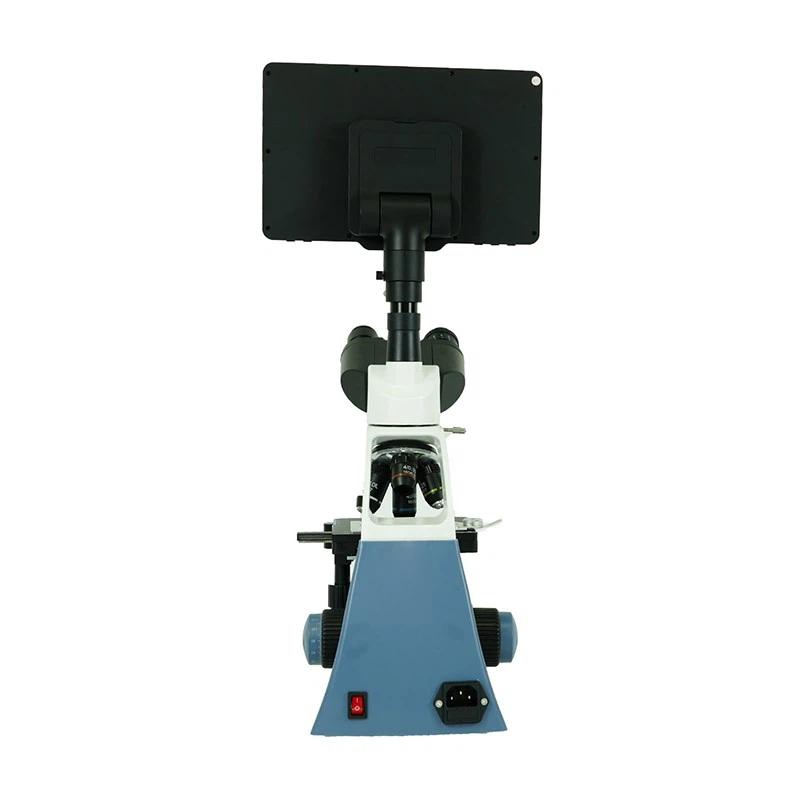
Pathologists can use LCD Microscope to examine tissue samples. By looking at the cells under the microscope, they can detect diseases such as cancer. The high - quality display helps them spot abnormal cells, which is crucial for early diagnosis and treatment.
Microscopic examination is also used in microbiology. Scientists can identify bacteria, viruses, and other pathogens using display microscopes. This information is vital for developing vaccines and antibiotics. For example, during the COVID - 19 pandemic, researchers used advanced microscopes to study the virus's structure, which was a key step in understanding how it spreads and how to fight it.
In dental clinics, dentists use microscopes to examine teeth and gums. They can detect early signs of tooth decay, gum disease, and other oral problems. The detailed display allows them to perform more precise dental procedures, such as fillings and root canals.
3. Industrial Inspection
Display microscopes are widely used in industries for quality control and inspection.
In the electronics industry, manufacturers use microscopes to inspect printed circuit boards (PCBs). They can check for defects such as short circuits, broken traces, and misaligned components. The high - magnification capabilities of the microscope ensure that even the tiniest flaws are detected. This helps improve the quality of electronic products and reduces the number of defective items.
In the manufacturing of precision parts, such as those used in aerospace and automotive industries, display microscopes are used to measure dimensions and check for surface defects. Engineers can ensure that the parts meet the strict quality standards. For example, they can measure the thickness of a coating on a part or check for scratches on a surface.
The Wifi Digital Microscope is especially useful in industrial settings. It allows workers to share images and data wirelessly. They can send the microscope images to quality control managers or engineers in different locations for further analysis. This speeds up the decision - making process and improves overall efficiency.
4. Research and Development
Researchers in various fields rely on display microscopes for their work.
In materials science, scientists use microscopes to study the properties of new materials. They can analyze the atomic and molecular structure of materials, which helps in developing new materials with improved properties. For example, they can study the structure of carbon nanotubes to understand their unique electrical and mechanical properties. This research can lead to the development of new technologies, such as more efficient batteries and stronger composite materials.
In environmental science, researchers use microscopes to study microorganisms in soil, water, and air. They can identify different species of bacteria, fungi, and algae, and understand their role in the ecosystem. This information is important for environmental monitoring and conservation efforts.
5. Forensic Science
In forensic investigations, display microscopes play a crucial role.
Forensic scientists use microscopes to examine evidence such as hair, fibers, and fingerprints. They can analyze the characteristics of hair, such as its color, texture, and cross - section, which can help identify the source. Fibers found at a crime scene can be examined under the microscope to determine their type and origin. This information can be used to link suspects to the crime scene.
Fingerprint analysis is another important application. Microscopes can magnify fingerprints to reveal fine details such as ridge patterns and minutiae. These details are unique to each individual and can be used as evidence in court.
6. Jewelry and Gemstone Inspection
Jewelry makers and gemologists use display microscopes to examine precious stones and metals.
They can check for inclusions, cracks, and other flaws in gemstones. The microscope helps them determine the quality and authenticity of the stones. For example, a diamond with fewer inclusions is considered to be of higher quality. By using a microscope, gemologists can accurately grade diamonds and other gemstones.
In the case of jewelry, microscopes are used to inspect the craftsmanship. They can check for soldering defects, misaligned settings, and other manufacturing flaws. This ensures that the jewelry meets the high - quality standards expected by customers.
Why Choose Our Display Microscopes?
We offer a wide range of display microscopes with different features and specifications. Our microscopes are known for their high - resolution displays, excellent magnification capabilities, and user - friendly interfaces. Whether you're a teacher, a medical professional, an industrial worker, or a researcher, we have the right microscope for you.
Our team of experts is always ready to provide you with technical support and advice. We can help you choose the best microscope for your specific needs. And if you have any questions or concerns, we're just a message away.
If you're interested in purchasing our display microscopes, we'd love to have a chat with you. We can discuss your requirements, provide you with a quote, and help you make an informed decision. Contact us to start the procurement process and take your work to the next level with our top - quality display microscopes.
References
- "Microscopy in Biology Education: A Review", Journal of Science Education
- "Medical Microscopy: Principles and Applications", Medical Science Press
- "Industrial Microscopy for Quality Control", Industrial Technology Journal
- "Forensic Microscopy: A Key Tool in Criminal Investigations", Forensic Science Review
- "Microscopy in Materials Research", Materials Science Journal
So, there you have it! That's a rundown of the many functions of display microscopes. I hope this blog has given you a better understanding of how these amazing devices are used in different fields. If you have any thoughts or questions, feel free to leave a comment below.


