


Can a student microscope be used for forensic science studies? That's a question I've been asked a bunch of times as a student microscope supplier. And it's a pretty interesting one, so let's dig into it.
First off, what exactly is forensic science? Forensic science is all about using scientific methods to solve crimes and answer legal questions. It covers a wide range of stuff, like analyzing DNA, looking at fingerprints, and examining trace evidence. And microscopes play a huge role in this field. They let forensic scientists take a close - up look at all sorts of tiny things that could be crucial evidence.
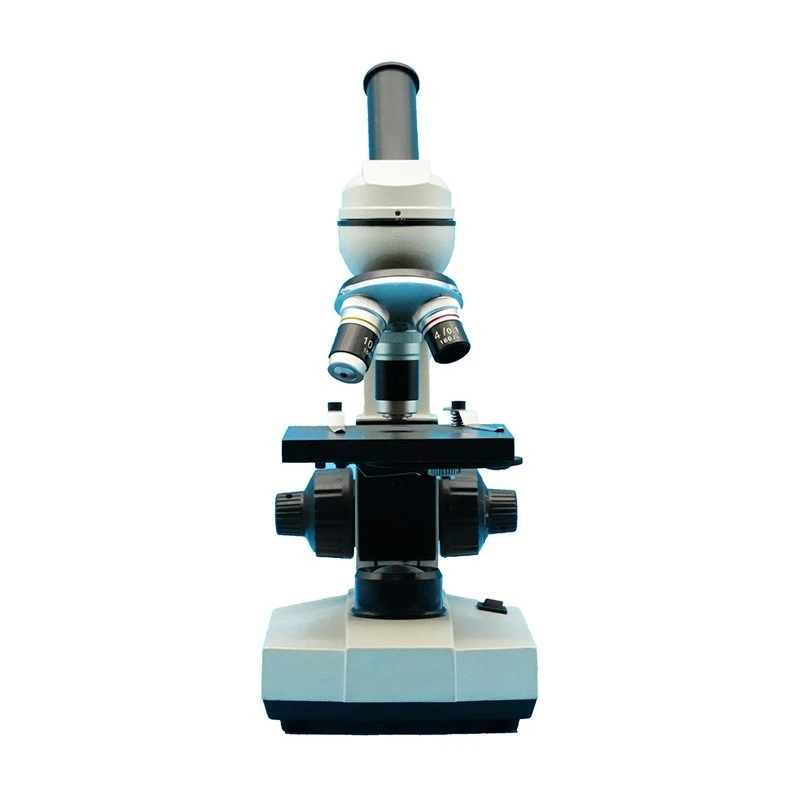

Now, let's talk about student microscopes. Student microscopes are designed mainly for educational purposes. They're usually more affordable and less complex than professional - grade microscopes. But that doesn't mean they're completely useless for forensic science studies.
One of the key features of a microscope in forensic science is its magnification power. Most student microscopes can offer magnifications up to 400x or 1000x. For example, our Monocular 1000x Biological Student Microscope can reach a magnification of 1000x. This level of magnification can be useful for some basic forensic science tasks. You can use it to examine hair samples. Hair can tell a lot about a person, like their race, and sometimes even if they've been using drugs. Under a 1000x magnification, you can see the hair's cuticle, cortex, and medulla, which can provide important clues.
Another area where student microscopes can be handy is in the study of fibers. Fibers from clothing or carpets can be transferred at a crime scene. With a student microscope, you can look at the color, shape, and texture of these fibers. You might be able to match them to a particular source, like a specific type of fabric used in a suspect's clothing.
For elementary students who are just starting to learn about forensic science, our Microscope for Elementary Students is a great option. It's simple to use and can still give them a basic understanding of how microscopes work in forensic investigations. They can use it to look at things like pollen grains, which can be found at a crime scene and might indicate the location where a crime took place.
However, student microscopes do have their limitations when it comes to forensic science. Professional forensic microscopes often come with advanced features that student microscopes lack. For instance, they may have better resolution, which is crucial for seeing fine details. In forensic science, even the tiniest detail can be a game - changer. High - end microscopes also have features like polarized light microscopy, which can be used to analyze things like glass fragments and minerals. Student microscopes usually don't have this capability.
Also, professional microscopes are more durable and can withstand the heavy - duty use that forensic laboratories often require. Student microscopes are built with a more general educational use in mind, so they might not hold up as well under constant, intense use.
But for educational institutions or individuals who are just starting to explore forensic science, student microscopes can be a great starting point. They're a cost - effective way to get hands - on experience. Our Student Biological Microscope is a popular choice for this kind of exploration. It's easy to operate and can help students learn the basics of microscopy in the context of forensic science.
If you're thinking about using student microscopes for forensic science studies, here are a few tips. First, make sure you have the right preparation techniques. For example, when examining a sample, you need to prepare it properly on a slide. This might involve staining the sample to make certain features more visible. Second, practice using the microscope to get the best focus and magnification. It takes a bit of skill to get a clear image.
In conclusion, while student microscopes have their limitations in forensic science, they can still be a valuable tool, especially for educational purposes and for those just starting out in the field. They can provide a good foundation for learning about the role of microscopes in forensic investigations.
If you're interested in purchasing student microscopes for your forensic science studies, whether it's for a school project or a budding forensic science enthusiast at home, feel free to reach out. We're here to help you find the right microscope for your needs.
References
- Saferstein, R. (2019). Criminalistics: An Introduction to Forensic Science. Pearson.
- James, S. H., & Nordby, J. J. (2009). Forensic Science: An Introduction to Scientific and Investigative Techniques. CRC Press.


